Showing posts with label Germany. Show all posts

Wednesday, June 11, 2025

Kandinsky and the Compositions - Part II

(This stub is edited with some updated links that work, for those that want to go where the yellow brick road leads!)

It's a repub of a 2005 piece I wrote.

Ok... now that I have found out I am refreshed enough to blog the world for the 4th time in under 24 hours... onwards and upwards... This time the word is...Composition X

WELL... this dates back to 1939. Although started in 1938 sometime when Kandinsky was in Paris... it was a more painstaking effort and perhaps the most vibrant of all. At least definitely my favourite. Obvious isn't it? The predominating BLACK in the background and all those flying lines and curves ... it's like a MARDI GRAS IN SPACE for me! Yes, the work actually was started in 1938. But I was kidding. Wassily started it in Dec 1938 and finished in Jan 1939!

Composition 10 is the last in the series of Compositions. Sometimes am confused whether it is Comp 10 or Comp X - meaning the unnumberable one like the number 'n' in mathematics. Or is it like Mr. X? Well, your guess is as good as mine. Anyway... it is even more remarkable compared to the other Compositions because of its radical departure from fuzziness in some of the other predecessors of this discerning series.
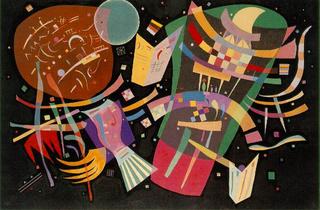
Look at the image. You will understand. There is no hesitation. There is a certain clarity. There is absolute playfulness that had been arrived at through long obsessive hours of discerned and calculated seminal-texture to this theory of the use of color, space, lines, curves and ultimately the canvas (Read with a CAPITAL C!)

Composition X actually belongs to his late works as well. And it not only completes the Compositions series, but also connectes with later works as a link. It is less murky, more relaxed, even cheerful. And it's grammar and idiom are more formalised.Well, in a sense it is a darker painting in that everything is hovering about. Notice in the pix above the bio-morphic formations... the embryonic quality to the image segments. More a picture for joyous study to some biology student and life-science student. Biomorphic... embryonic and cell-shaped structures dominate... inspite the dark and brown-black background.This was to become the unique feature of Kandinsky's work, in retrospective analytical terms, I mean.According to Kandinsky "Black was the least expressive colour"... but on which any colour can express itself.

To quote him "Black was the least expressive colour on which every other colour, even those with the least power of expression can express more strongly, more precisely". The cheerful impression which results from the strong contrast of colours is juxtaposed against (or should I say married with) the foregrounding of more brighter colours. It is very Russian. The concentration of dark hues and scientific touch to any subject. And what of the zoomorphic and biomorphic forms? He recognised the expression of cosmic laws in the general organic nature, the processes of regeneration and new beginnings of life, which he attempted to present in pictorial form... but in his own geometric but abstract style.Composition X is the supreme example and the quintessence of Kandinsky's art.

We will next quickly take comparitive peek at his contemporary and soul-mate Oskar Schlemmer's work. That would lead us to the Bauhaus connection.

Sunday, November 15, 2009

THE FALL OF THE WALL, I and 15 years later...

One of the many events that happened nationally and internationally in recent times that affected me severally is the 20 years celebration of the Fall of the Berlin Wall. For various reasons. Combine with it my recent re-reading and re-watching of Henry Porter's BRANDENBURG (a 2005-06 novel) and the 2006 movie THE LIVES OF OTHERS respectively. Of course, a movie such as GOODBYE, LENIN is always at the back of my mind!

Leaving aside the drama, the sentiment, the euphoria, the pyrotechnics and the laser show that sorrounded this event, the sheer monolithic monstrosity of the history behind the wall's existence leaves me breathless and disturbed... more because when I visited Germany the first time, it was hardly 5 years after the re-unification, when the old habits and memories of a land lost by a tribe of people who had set their store by a system - whether they liked it or not - through sheer habit still hung around like hangover from previous night's party!

I went back and dug into the net, dug into my shelf of German literature, German magazines and newspapers I had brought back upon that first visit. Memories come crowding. At that time, I was just a keen-eyed first time visitor to Germany. I did not comprehend the enormity of my stay. I am now trying to put all the shards of experiences and observations of my day-to-day existence over 8 months in places such as Magdeburg, Berlin, Halle, Leipzig, Wernigerode and other quaint little erstwhile East German towns - irrespective of long or short my stay or visits was/were! I even visited the Staatssicherheit's (STASI) headquarters in Leipzig, which was a very very eye-opening and cleansing visit for my soul.

To see the Nikolaikirche, visit Auerbach's Keller blessed with Goethe's feet, body, spirit and sould, walk about the Denkmal and have an esoteric experience of a Russian Orthodox Church Sunday Mass and then to spend about 2 hours on the Open Day at STASI hq in Leipzig - now to think of all these - I do not know what to do with all these accumulated experiences. This is but one day of the several days I visited Leipzig, when I was not collecting materials for my research or visiting famous and not so famous, but experimental theater houses or tourist sites in the rest of Germany or taking advantage of my several friends inhabiting all sorts of towns and cities all across Germany from Schewerin to Constance, Aachen to Frankfurt-Oder, Aurich to Dresden. This is but one of the 3 visits to Germany over a decade between 94-95 and 2004. How many, how many experiences, how many, how many memories, how many, how many memories now come flooding as a result of waking through the night of 20 years of Fall of the Wall celebrations on the Brandenburg Tor! Thank you DW-TV for bring the event live and better than BBC or CNN or anyone else outside of Deutschland.

I think I shall create a new blog exclusively dedicated to recapturing my German days. One post or even 10 posts won't be enough in the next coming days. For now, after 15 years since my first day, when my friend Thorsten picked me up at Berlin-Tegel, I realise it is a complex socio-political and artistic as well as cultural broom that I am trying to assimilate straw by straw that shall ultimately help me clear the cobwebs of my existence! It is humbling, to say the last word.

Saturday, April 29, 2006

A Lab for the Future of Theatre for Children and Youth


The following is a translated version of a news item I came across in Rheinische Post, to which I subscribe online. In the light of some comments and discussions we have been having here famously, I thought this news article merits a reproduction (in full as is normal the courtesy to be adhered to when one reproduces something) to show what we are not doing in our own backyard.
* * * * *
Düsseldorf (dto). “We only want to play!“ is the title of the 22nd N(orth) R(hine) W(estphalian) Children’s and Youth Theatre Seminar that is happening this Saturday (Apr 29) in Düsseldorf. The future of youth would be thematised in the form of several seminars, theatre performances, and discussions. The campaign is supported by Artistic Director Sönke Wortmann and the Junior Soccer Team of Fortuna Düsseldorf.
Theatre artists across the entire NRW are currently experimenting with the Language, Presentation, and Aesthetics in the area of contemporary theatre for children and youth. The proposed project revolves around a sensory Culinary Experience of the stage, movement in public space, the “aimless idling in an empty space”, fairy tales, Biblical stories and societal changes. Three public seminars with their focal points on the themes “Economising of Living Conditions,” “Attitudes of Generations” and “Images of Cultural Hostility” are the crux of this Lab about the Future.
The official festive opening takes place in Düsseldorf on Sunday (Apr 30). The key figures of attraction include the main patron of this event Hans-Heinrich Grosse-Brockhoff, Heinz Winterwerber (Mayor of Düsseldorf), Wolfgang Schneider (President of the International Union for Children’s and Youth Theatre), Artistic Director Sönke Wortmann, Theatre author Lutz Hübner, Felicitas Loewe (Chief Dramaturge of the Theater Junge Generation [Theatre of the Young Generation] in Dresden) and Film director Rolf Losansky; the high point would be the appearance of the Youth Soccer Team of Fortuna Düsseldorf.
On the opening night on April 30, the currently running theatre production “The Last Show” would be performed. The musical play deals with Performance Pressure and the cult of Beauty Obsession, and is aimed at 14+ age group. In the following five days, there would be further performances at Datteln, Bonn, Cologne, Essen, Moers, Hagen, Gelsenkirchen, Bad Münstereifel und Oberhausen.
On the last day of the seminar, May 5, all the projects at the Lab for Future would be brought before public as open performances at the Children’s and Youth Theatre space. In every room and corner these artistic experiments would be exhibited. The audience would be able to go through the entire theatre house and meet finally at the main auditorium. The 22nd N(orth) R(hine) W(estphalian) Children’s and Youth Theatre Seminar would eventually conclude with a prize distribution.
* * * * *End of Article* * * * *
What is happening in Chennai in theatre in general is: people are doing too much arbitrary performance work and unnecessarily putting pressure on each other by raising the commercial stakes. One might say that we need to be really extra-sensory with sponsors. This is my take. From “beggars for sponsorship” days we have just progressed to “glorified beggars for sponsorship.” By pushing ourselves unnecessarily into packaging and project proposals and statistics and presentations of power-points in cds and laptops, we are moving theatre into an unrequired area of management culture.

I am not speaking thus because am lazy or cannot meet up with the corporates and produce an hour of their own jargonizing… but because we are artists… people who can do what they cannot… people who bring relaxation and refreshment and rejuvenation to their workaholic lives. We must not seek them, they must seek us. If we commercialize art too much to the level of consumerism, the moneyed people would take (and have already started taking) advantage of our position.
I shall explain: if you looked at it, because people come to watch us perform, the product owners have a direct marketing reach through theatre. One might claim that there is more mileage in an ad in The Hindu because it reaches so many million people. One might claim that there is so much visibility in airing a video ad. True and false. Truth be told, advertisement only proposes to campaign, doesn’t promise to sell. And when has advertisers actually come to our doors asking us to buy. Those are the salesmen. So what guarantee is it that the ads are being noticed? Not every ad. Touch your heart and tell me: do you really go through all the ads in the daily each day… or collect each and every sheet that is tucked into your newspaper? You shake them off and read the news item! Whereas in theatre the visibility is concentrated and high. So, theatre has a better reach and power of sustenance. As a result we must be approached where we quote the price, not us approaching. We push ourselves to unnecessary desperation when we don’t need to. When so much theatre is happening and so many people watching theatre than before, corporates and product owners must consider it a privilege to reach out to their public through us.
How the hell does this relate to this post? I hear you! If we spend half our time on packaging and another quarter on publicizing the show, where is the time to produce meritoriously? Add to it, we are so bifurcated and divided that no three groups have identifiable incumbency of more than 3 people. So where is the question of having separate units inside the company that takes care of admin, tech, management, logistics and artistic areas? The same person has to do everything. That definitely brings down the quality and quantity of time one could put at rehearsals. And we are perennially producing and performing that we are not replenishing ourselves with newer ways of performing. As a result art is no more fresh. Just commoditised package of laughter or drama or musical!
Instead, we must stop spending too much time on chasing sponsors, start doing shows and more shows within given resources. If the quality of the story-telling is good, what need for people to notice the costume one wears or the colour filters one uses to wash the backdrop or the quality of the sets and backdrops? What did our forefathers rely on? Body, voice, gestures, movements, and playing space! But today all is topsy-turvy. Actor has vanished. Performer has been closeted, theatre has been pushed to background, and instead the proletarian need for crass entertainment has taken over the minds of those who do theatre more than those who come to watch. As a result we are giving stupid stuff that would safely meet the footfall requirement of the sponsor. The sponsor has stealthily started deciding what we do. It must stop!

If this be today, where do we have time to train new people, whet youth and teens to do the right kind of art? They are uninformed or less informed or misinformed because the informants don’t have a clue about what information to give. If theatre has to get professional, we need to start focusing on our youth theatre scenario, create a cultural climate by catching them in their teens before adolescence over-enthusiasm takes them over to think performance, going on stage and speaking lines and changing colorful costumes and taking curtain calls are the only things that count about theatre.
Now of course, there is this new found craze to do backstage… it means, less rehearsal time, more dating opportunities and getting drunk at cast parties at someone else’s expense. Of course, there are some cast parties that don’t happen or happen late or tepid or insanely boring, where you're even required to come in dress codes. But that’s not in our purview. The long and the short of the matter is we are losing the happiness of doing theatre and falling prey to bureaucratic work patterns rather than artistic passion.
What must happen in Theatre in Chennai:
People must speak honestly and work with integrity. One can be truthful and honest and yet carry on with life. After all, we come from the great country which bore the great person who said: “Hate a person’s action, not the person” – Mahatma Gandhi. I am sure we are all capable of speaking our minds. Except, we speak it only when we have decided we are ready to lose something. We must speak and act truthfully to retain a thing for its real value. WHAT WE REALLY NEED IS MORE HONESTY WITH OUR ART, MORE INTEGRITY TO OUR WORK AND MORE SELF-RESPECT. And we must develop the strength to say no to any and every work. More than work, we must stop encouraging passers-by with desultory attitude to someone else’s production money by refusing to work with them whether in our own shows or someone else’s.
That is the statement for the season.

Monday, January 30, 2006

A Genius of Clarity - Friedrich Schiller


(This was an article I had posted elsewhere that has ceased to exist. So just updating my web-presence with this and some other articles from past. Upon approaching the 200th anniversary of Schiller...)

Friedrich Schiller - the flamboyant heart and soul of German Literature!
Well, there was this article in Der Spiegel of 18th Oct. 2004. The title is as above. It's about Schiller and is about time we started taking stock of this flamboyant contemporary of Goethe. It's such a sin that we need to know of Schiller today in the context of Goethe, made an iconoclaustic better-known of the former's times. And I love the way Ruediger Safranski (59), a Schiller Biographer goes about how Schiller has been underestimated as a poet, dramatist, writer and most of all philosopher. He is the Poet as Philosopher.
Schiller, for the lay-men/women to German Literature, was a writer very popular in his time (aren't all geniuses and recognised writers so?). Today unfortunately Schiller is known more as a contemporary of Goethe and as a man mostly known to contemporary international audience through his stage plays such as Die Räuber (The Robbers) and Don Carlos. It doesn't say all. The man himself and his personality and his women and the sleaze that sorrounded him and his casual attitude to everything makes him more fascinating (why does an artist's sordid life attract people more than art itself? Remember Mozart? Monroe? Wilde? Oh, all you artist- and art-tits lovers, do you hear me?) and is made of stuff that makes biographies worth writing.
The first time we come to know of Schiller... So goes Volker Hage in his cover story on Schiller ('course am juicing it up a bit): "The first audience had come already about 1 pm to the theatre. They were told they were to wait for a Genius whose genius is much talked about and raved and touted about in Mannheim and the sorrounding art-circles. The 22 year old author, who was all the same at that time travelling from Stuttgart with his friend, just ran into a very buxom serving-lady of a tavern, whose company assumed more importance that he stayed behind in preference to a Performance that was supposed to start at 5 pm and expected to run for 5 hrs." What do we say? what do we assume?
And on 13 January 1782, his The Robbers opened. There was total chaos and the world broke loose and the foyer and balconies were straight out of Hell upon inhabitation by all the Fallen Angels floating about in the Phosporous Sea after being chucked out by God! The Myth has it so! The theatre was like a madhouse - rolling eyes, fiery faces, rolled fists, stamping feet, crescendoing cries of disgust in the audience area... That was Schiller's entry into the world of Theatre. Now, how dare one calls him Goethe's contemporary. Goethe never incited people to set fire... he may have set a few more hearts a-fire. But Schiller was better with his women as well! Schiller was a veritable Dantonian figure... the type of hero in real life that Büchner would have loved to immortalise.
But getting back to the Poet as a Philosopher... Schiller's idealism is all about how one continues to live longer through his power to impress, than through one's physical life on earth. Schiller achieves this through his capability to be playful with what he calls as 'perishable material'. How does one take inane stuff and make eternity out of it? To rephrase and vice-versa a statement by a Neil Simon character, the trick is in making a Goose-liver paté out of a Hero-sandwich. Consequently, we understand that we all do go down, but how much one extracts from life - without being competitive and getting motivation from outside, out of winning, doing everything to the best of enjoyment - well, Schiller's success as a writer comes from this. Is there a better ground-zero philosophy possible? Hegel and Fichte and Hölderlin held him in awe. He is compared with Sartre. Not that he needs a Sartre to compare against. But his existentialism smacked of the quintessential Sartrian hero who takes things by their balls and owns up the responsibility of success or failure thereof! And a man who explored (ask Safranski please!) more areas - poetry, literature, art, philosophy, politics and history... well what about science! - than Goethe ever did. Oh yes, he came very handy for some of the 19th century political movements, not to mention radicals, to quote from. How about this: his 100th birthday was celebrated as a national event in Germany by BOTH the Liberals and the commoners. He belonged to all. That probably was his weakness... exposing and keeping himself fundamentally accessible to all and sundry. He could never be a Goethe you see, elitism was not in him! Am I eulogising him? You bet, if you don't believe what am saying, listen to the man himself: "A Person is a whole person only where he plays." Like his Marquis Posa says, "Sire, give Freedom of Thought". Well, therein lies the core of a writer, the Might of the Word as against the Words of the Mighty!
We are around the bend at marking his 200th death anniversary. For a detailed celebration of this genius of freedom, hang in there till 9th May 2005. Oh, shall provide a timeline of his life, shortly. Until then... Vive la Freedom!

Friday, May 27, 2005

Kandinsky and the Compositions - Part I

Ok, here it is... for a long time, I have been threatening both on blog and in real time to put up something on Wassily Kandinsky. There it is finally.

Dear art-unsavvy friends of mine, please bear with this. Seek info in real time if it interests you!

Compositions

Kandinsky created a total of 10 large format pictures all entitled Composition(s). The series is titles Compositions (obvious, idn't it?)

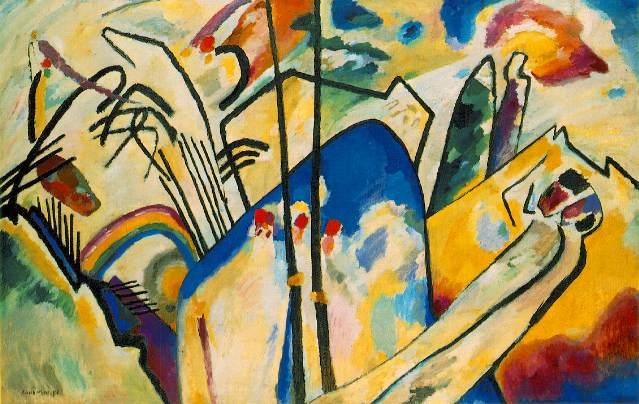
Composition IV - 1911

Composition IV is one of his major works - esp during his transition phase from depictive shapes to abstraction.Kandinsky freed lines off the function as just outlines and created a certain pictorial vocabulary (I love the expression, freeing lines of outline function. True isn't it how warped we are and use lines as just geometric slave-frames!) that really placed equal importance and emphasis on lines and colour.

According to him, a composition is "made up of the contrasts between masses, lines and colours, and only secondarily of objects to which the representation alludes". Several of the elements in Comp. IV such as the mountain, the Cossacks, the rainbow at the back, the twin figures or the gallopping horses in the top left hand section refer to predetermined objects and figures. Of course, abstractionists would readily notice that. Conservative naturalistic and realistic minds would take a while to figure out. But this is Expressionism we are talking. And the Man of the Bauhaus Movement!

The combined effect of primary and secondary motifs (and thematic constructs to go with it), the edgy but deliberate nervous and patchy style of painting, the stark colourfulness and powerful imagination veil the picture's fundamental structural composition.

Look how the vertical axis divides the picture so effortlessly into two halves: the mountains with the motifs depicted on top of them provide almost a third section. For a desultory eye, the 3rd section is almost part of the second. But not really so! A diagonal line adds a certain kinetic - even dynamic - touch to this composition.

Watch out for other compositions. And my links to a Kandinsky web-page in the Links section shortly, comprising jpg reproductions of his works. They are available all over the web. But am compiling them for an avid Wassily enthusiast.