It's a repub of a 2005 piece I wrote.
Ok... now that I have found out I am refreshed enough to blog the world for the 4th time in under 24 hours... onwards and upwards... This time the word is...Composition X
WELL... this dates back to 1939. Although started in 1938 sometime when Kandinsky was in Paris... it was a more painstaking effort and perhaps the most vibrant of all. At least definitely my favourite. Obvious isn't it? The predominating BLACK in the background and all those flying lines and curves ... it's like a MARDI GRAS IN SPACE for me! Yes, the work actually was started in 1938. But I was kidding. Wassily started it in Dec 1938 and finished in Jan 1939!
Composition 10 is the last in the series of Compositions. Sometimes am confused whether it is Comp 10 or Comp X - meaning the unnumberable one like the number 'n' in mathematics. Or is it like Mr. X? Well, your guess is as good as mine. Anyway... it is even more remarkable compared to the other Compositions because of its radical departure from fuzziness in some of the other predecessors of this discerning series.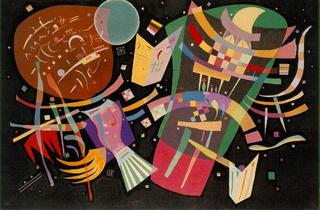
Look at the image. You will understand. There is no hesitation. There is a certain clarity. There is absolute playfulness that had been arrived at through long obsessive hours of discerned and calculated seminal-texture to this theory of the use of color, space, lines, curves and ultimately the canvas (Read with a CAPITAL C!)
Composition X actually belongs to his late works as well. And it not only completes the Compositions series, but also connectes with later works as a link. It is less murky, more relaxed, even cheerful. And it's grammar and idiom are more formalised.Well, in a sense it is a darker painting in that everything is hovering about. Notice in the pix above the bio-morphic formations... the embryonic quality to the image segments. More a picture for joyous study to some biology student and life-science student. Biomorphic... embryonic and cell-shaped structures dominate... inspite the dark and brown-black background.This was to become the unique feature of Kandinsky's work, in retrospective analytical terms, I mean.According to Kandinsky "Black was the least expressive colour"... but on which any colour can express itself.
To quote him "Black was the least expressive colour on which every other colour, even those with the least power of expression can express more strongly, more precisely". The cheerful impression which results from the strong contrast of colours is juxtaposed against (or should I say married with) the foregrounding of more brighter colours. It is very Russian. The concentration of dark hues and scientific touch to any subject. And what of the zoomorphic and biomorphic forms? He recognised the expression of cosmic laws in the general organic nature, the processes of regeneration and new beginnings of life, which he attempted to present in pictorial form... but in his own geometric but abstract style.Composition X is the supreme example and the quintessence of Kandinsky's art.
We will next quickly take comparitive peek at his contemporary and soul-mate Oskar Schlemmer's work. That would lead us to the Bauhaus connection.
WELL... this dates back to 1939. Although started in 1938 sometime when Kandinsky was in Paris... it was a more painstaking effort and perhaps the most vibrant of all. At least definitely my favourite. Obvious isn't it? The predominating BLACK in the background and all those flying lines and curves ... it's like a MARDI GRAS IN SPACE for me! Yes, the work actually was started in 1938. But I was kidding. Wassily started it in Dec 1938 and finished in Jan 1939!
Composition 10 is the last in the series of Compositions. Sometimes am confused whether it is Comp 10 or Comp X - meaning the unnumberable one like the number 'n' in mathematics. Or is it like Mr. X? Well, your guess is as good as mine. Anyway... it is even more remarkable compared to the other Compositions because of its radical departure from fuzziness in some of the other predecessors of this discerning series.

Look at the image. You will understand. There is no hesitation. There is a certain clarity. There is absolute playfulness that had been arrived at through long obsessive hours of discerned and calculated seminal-texture to this theory of the use of color, space, lines, curves and ultimately the canvas (Read with a CAPITAL C!)
Composition X actually belongs to his late works as well. And it not only completes the Compositions series, but also connectes with later works as a link. It is less murky, more relaxed, even cheerful. And it's grammar and idiom are more formalised.Well, in a sense it is a darker painting in that everything is hovering about. Notice in the pix above the bio-morphic formations... the embryonic quality to the image segments. More a picture for joyous study to some biology student and life-science student. Biomorphic... embryonic and cell-shaped structures dominate... inspite the dark and brown-black background.This was to become the unique feature of Kandinsky's work, in retrospective analytical terms, I mean.According to Kandinsky "Black was the least expressive colour"... but on which any colour can express itself.
To quote him "Black was the least expressive colour on which every other colour, even those with the least power of expression can express more strongly, more precisely". The cheerful impression which results from the strong contrast of colours is juxtaposed against (or should I say married with) the foregrounding of more brighter colours. It is very Russian. The concentration of dark hues and scientific touch to any subject. And what of the zoomorphic and biomorphic forms? He recognised the expression of cosmic laws in the general organic nature, the processes of regeneration and new beginnings of life, which he attempted to present in pictorial form... but in his own geometric but abstract style.Composition X is the supreme example and the quintessence of Kandinsky's art.
We will next quickly take comparitive peek at his contemporary and soul-mate Oskar Schlemmer's work. That would lead us to the Bauhaus connection.




 Posts
Posts

