Showing posts with label Art. Show all posts

Wednesday, June 11, 2025

WATER LILIES by Gowri Ramnarayan

This is happening, on July 5-6, 2025 people, in Bengaluru! Do grab those Early Bird offers! 

Our InstaPost Link: 
https://www.instagram.com/p/DKmoLaYobeO/?igsh=bnh6NnBxczM4Y3Y

Ticket link: 
https://allevents.in/bangalore/water-lilies-english-theatre-play-tickets/80003935014713

Kandinsky and the Compositions - Part II

(This stub is edited with some updated links that work, for those that want to go where the yellow brick road leads!)

It's a repub of a 2005 piece I wrote.

Ok... now that I have found out I am refreshed enough to blog the world for the 4th time in under 24 hours... onwards and upwards... This time the word is...Composition X

WELL... this dates back to 1939. Although started in 1938 sometime when Kandinsky was in Paris... it was a more painstaking effort and perhaps the most vibrant of all. At least definitely my favourite. Obvious isn't it? The predominating BLACK in the background and all those flying lines and curves ... it's like a MARDI GRAS IN SPACE for me! Yes, the work actually was started in 1938. But I was kidding. Wassily started it in Dec 1938 and finished in Jan 1939!

Composition 10 is the last in the series of Compositions. Sometimes am confused whether it is Comp 10 or Comp X - meaning the unnumberable one like the number 'n' in mathematics. Or is it like Mr. X? Well, your guess is as good as mine. Anyway... it is even more remarkable compared to the other Compositions because of its radical departure from fuzziness in some of the other predecessors of this discerning series.
Look at the image. You will understand. There is no hesitation. There is a certain clarity. There is absolute playfulness that had been arrived at through long obsessive hours of discerned and calculated seminal-texture to this theory of the use of color, space, lines, curves and ultimately the canvas (Read with a CAPITAL C!)

Composition X actually belongs to his late works as well. And it not only completes the Compositions series, but also connectes with later works as a link. It is less murky, more relaxed, even cheerful. And it's grammar and idiom are more formalised.Well, in a sense it is a darker painting in that everything is hovering about. Notice in the pix above the bio-morphic formations... the embryonic quality to the image segments. More a picture for joyous study to some biology student and life-science student. Biomorphic... embryonic and cell-shaped structures dominate... inspite the dark and brown-black background.This was to become the unique feature of Kandinsky's work, in retrospective analytical terms, I mean.According to Kandinsky "Black was the least expressive colour"... but on which any colour can express itself.

To quote him "Black was the least expressive colour on which every other colour, even those with the least power of expression can express more strongly, more precisely". The cheerful impression which results from the strong contrast of colours is juxtaposed against (or should I say married with) the foregrounding of more brighter colours. It is very Russian. The concentration of dark hues and scientific touch to any subject. And what of the zoomorphic and biomorphic forms? He recognised the expression of cosmic laws in the general organic nature, the processes of regeneration and new beginnings of life, which he attempted to present in pictorial form... but in his own geometric but abstract style.Composition X is the supreme example and the quintessence of Kandinsky's art.

We will next quickly take comparitive peek at his contemporary and soul-mate Oskar Schlemmer's work. That would lead us to the Bauhaus connection.

Thursday, March 26, 2020

World Theatre Day 2020

Coming Soon @ Masquerade, Chennai

World Theatre Day 2020 - Masquerade Chennai
Masquerade presents World Theatre Day 2020
A FREE TO REGISTER, public participation event, inviting artists and theatre enthusiasts to join in celebrating World Theatre Day. The day is being celebrated for the 22nd year in Chennai by Masquerade – the performance group, ChennaI. For more details on World Theatre Day, visit: https://iti-worldwide.org/worldtheatreday.html
Some may say this is not the time to celebrate. But in times of contagion and life threatening crisis like this, if we do not celebrate life, and its ONE TRUE MIRROR, live theatre, when then?
It is our responsibility and privilege as artists to exhibit freedom… Come join us, the online stage is yours.
Public Performance Event
Genre: Any that you may choose
Duration : 1 to 10+ minutes (not exceeding 12 please)
Language : Tamil, English or Mime preferably (but any that you may choose)
PS: Nothing Filmy, or anything from films. Create your own original piece. WE WANT YOU TO BE YOUR ORIGINAL YOU. We want your theatrical talent to be featured, showcased. Please do grace our World Theatre Day celebrations with YOU.
This is not an age restricted event. Young talents are allowed too. Therefore, in public interest, Strictly please, no verbal or physical violence, political, personal or COVID19 propaganda statements.
REGISTRATION & PARTICIPATION FREE.
YOU CAN EVEN PARTICIPATE AS A DUO OR GROUP SO LONG AS YOU’RE ON SAME SCREEN AND HANDLE
To Register CLICK HERE

Monday, October 02, 2017

Surendra Verma's FROM SUNSET TO SUNRISE

We Present to you...

On OCTOBER 7 & 8, 2017

At Spaces, Besant Nagar, CHENNAI

Time: 7:15 p.m

Duration: 1hr 50 mins (with 10 min. intermission)


All Are Welcome - Entry Free

Thursday, October 06, 2005

Art, Abstract Art, Avant-garde!

Art to me is a survival skill. It is an extremist subterfuge of individual mind that revolts against the lack of aesthetic ways to project the internal rumbles of human existence in response to external happenings. Art tries to portray reality invariably. Even when it is the surrealist art of a painter such as Salvador Dali or the French cubists, symbolists, impressionists and pointilists, it has reality as its base.

Pointillism (note the DOUBLE LL), for the uninitiated, was a very brief movement that attempted to portray, paint or project everything on canvas through points... of various sizes and layers of clarity.
Getting back to reality! Art can reflect life... else where shall the mind take points of reference from? As much as man created god, man created and creates art. From what he knows best. Life. Hence any art is real. Like B.B.King said once about music. "There is no good music or bad music, there are only good performances or bad performances". How true!

A work at its root - whether existing and re-produced in the case of a theatrical presentation, or executed to its concreted reality on canvas or any projectable material that can hold the conception and ideas in a defined form in the case of a painting, sculpture, installation etc... is basically existent in the human mind before it can be translated for the view of others. So, it is abstract as long as it exists in the domain of the unseen, in the vast space of the conceiver's mind. Only its realisation is precise or unclear. Hence concrete or abstract. Hence, as a natural existence, good art or bad art. And thence, good artist or bad artist. When I say concrete I mean clarity. Even the so called abstrct art can be clear. The colours, the daubing, the sketching, the shades, the deliberate chaos of pastelling may look hazy that for people who are not focussed it may seem like un-sense. I use the word consciously as an apposite opposite to sense. If one delves into the history of abstractionism, it would become clear. I have been delving into this territory for more than 2 decades now and it neve ceases to amaze me as much as post-modern art.

Artists don't vegetate. They can't. They try to overcome the banality of our mundane existence and aspire to transcend to a higher level. Art can also be escapist when it becomes a vehicle for expression of their suppression or repression or smothered lives under political anarchy and fascism. A classic example is the way Abstract Art came into existence.

Abstraction in art is often misunderstood for modern art... or art that cannot be comprehended. The word "abstract" is the most profoundly misunderstood, misquoted, misused and misinterpreted word in human language. When one cannot understand, people conveniently term it abstract. Not fair, especially when given the rise, development and history of Abstract Art, which is sometimes made synonymous with the term "non-figurative" because there are no clear portraits or natural depiction or concrete form discernible.

Abstract one should understand is a deliberate act of disfiguring the concrete or the real or the formative. Why? Why would one deliberately disfigure? Because they cannot or are not permitted to express clearly what they want to. We shall not talk about representations that are inchoate (verbally) or illegible (in calligraphy) or improperly expressed (some conceptions are not yet ready to be expressed and people are in a hurry to say, or they don't have enough vocabulary to express thoughts too big for words yet) or badly painted. We are talking of any sort of subversion. To explain: a person who is infracting or infringing but smart enough to say only part of the actual, yet the information is basically correct and true and complete and satisfactory enough to the receiver. To elucidate and exemplify: The Pandavas act of saying "Ashwathama atho..." Before the actual true sentence could be completed, Krishna chooses to blow the conch so that the full sentence "Ashwathama the elephant is dead" falls in Drona's ear at "Aswathama... is dead". That is a finer level of subversion. In art, subversion is committed to express that point of view they want to, but will not be entertained or encouraged or would even lead to subjection. We know very well what happened to Antigone in the Greek Myth, don't we? We know what happened to Prometheus who dared to bring light unto mankind, don't we? And there are examples... So, art has to use subversions, subterfuges, artifices, conceit as a form of expressing itself. The people who are the intended targets always get to comprehend abstract art.

So where then could it have been born? It was born when suppression was born. At which point of human history did it achieve its height? During the turn of 19-20th century in France... at the birth of 20th century... during the Nazi regime. The Jews, the Poles and the Islamic community are pastmasters of Abstract Art. Because they are the most subjected race. Of course, the Jewish subjection goes back to Shakespeare and Elizabeth. I like Shakespeare's works as brilliant watershed for performance, but I disaver from his projection of his villains. Shylock: who portrayed him? Shakespeare the Christian. Caliban (I provide this specific link because it is an article closer home to my own politics of The Tempest by William Shakespeare): who created him? Shakespeare the Christian. But what Shakespeare himself moral? Was he not a fag? Did he not stoop to please Elizabeth and the authority? True portrayal of the negative would come from those who are of the same stock and have suffered and portray to show the angst and the pain and the effects thereof on them and on the related community or society or civilisation. So, Shakespeare is a villain who deliberately disfigured truth to his own ends. Shakespeare was a subvert. But we are digressing.

The Poles, the Jews, the Islamic. I would suggest you all to take a look at the Works of Joan Miro, Wassily Kandinsky, Kasimir Malevich, Jackson Pollock to get an idea of how varied Abstract in Art can be depicted, and yet with clarity. The moral of the story, as I conclude: to make clear to people who are confused about Abstract. I shall now proceed to do the same about Post-modernism, which is often confused as well.

Sunday, October 02, 2005

Thomas Berger's "Who Is Teddy Villanova?" as a Barthian post-modernist fiction

Thomas Berger’s Who’s Teddy Villanova? as a Barthian post-modernist fiction

(This is a paper I had presented at the Wednesday Circle of the Professors of Department of Languages and Liberal Arts, University of Magdeburg, Germany, during my stint in 1995-96. I have reworked and rewriten and modified the paper to make it more current.)

John Barth, in his essay entitled ‘The Literature of Replenishment: Post-modernist Fiction,’ writes: “My ideal post-modernist author neither merely repudiates nor merely imitates either his twentieth-century Modernist parents or his nineteenth-century pre-modernist grandparents… (he) should hope to reach and delight, …beyond the circle of what (Thomas) Mann used to call the Early Christians: professional devotees of high art.”

Barth further writes, in specific reference to the post-modernist fiction: “The ideal post-modernist novel will somehow rise above the quarrel between realism and irrealism, formalism and “contentism,” pure and committed literature, coterie fiction and junk fiction. Alas for professors of literature, it may not need as much teaching as (James) Joyce’s or (Vladimir) Nabokov’s or (Thomas) Pynchon’s books, or some of my own.” [For the information of new, uninitiated readers, John Barth’s THE SOT-WEED FACTOR is one of the long-standing essentials of past-post-graduate studies!)

At the same time, Barth feels that this ideal work will not be off-handed or too light or frivolous, rather it will be delighting and call for further re-readings.

The writings of the contemporary American novelist, Thomas Berger, well qualify to meet the demands of Barth’s expectations. Berger’s writings have ranged from a mock-epic on the Frontier West and Custer’s Last Stand (Little Big Man), through a work set in the American 30s (The Feud) to Who Is Teddy Villanova? (WITV), a detective pot-boiler, and Nowhere, a novel, the events of which happen in a Utopian Land (deja-vu Samuel Butler’s Erewhon !). He has written (at the time of my seminar) fourteen works of fiction since 1958.

Of all these, his 1977 detective fiction written in the form of a pot-boiler novel, Who is Teddy Villanova? can be termed as a stand-offish attempt among his corpus. Of course, no two works of Berger are similar in context or genre; but his Reinhart Tetralogy deal with the same context, Little Big Man has a sequel and so on…; hence WITV is a very different attempt.

Almost all of his fictional works, much like the entire corpus of the post-modern fiction, have language as the theme, and irony and satire as the technique, even while trying to emphasise the spirit of cultural subversion and anarchy that this movement has come to be reckoned by the critics of literature. Where this particular work differs is in its generical approach. Instead of resorting to the standard and high-priestly approach towards writing (post-modernist and post-structuralist writing in particular), much like the writing of Philip Roth, Donald Barthelme or Thomas Pynchon, (not to mention the encryption-fiction writings of Umberto Eco, paperback Dan Brown and some of the Calvinos), Berger chooses the medium of what is called ‘the popular and kitsch novel’ better known as pot-boiler fiction.

Berger uses this medium to portray his concern for the individual in a world polluted with deception, cunning and disguised realities. According to Prof. Hassan, “Power and Fraud rule that world, distorting appearances and realities, pressing man to the limits of his sanity, and pressing him on the guilt-ridden role of victim or aggressor. But threats also contain their own answer, and shields may be fashioned of weapons. Man’s response, therefore, is to adopt a stance of knowing craziness, resilient simplicity, or defensive defenselessness.”

Berger’s weapon to combat the cultural and social threat takes the form of language. His hero, Russel Wren, is a former teacher of English from State University New York, turned detective by the quirk of fate. He has “…literary pretensions and a style that Samuel Johnson might have developed had he been born 250 years later in New York…” Throughout the work, he juggles with the art of literary parataxis, as much as Berger interests himself for both verbal arrangement without connective as well as parataxis of ideas.

At the very beginning, this is how Wren introduces himself:

I was an unlicensed private investigator, but I possessed an unlicensed firearm… (pressed upon me once, and then forgotten, by a client who, suspecting his wife had taken a lover, had worked a ruse-suicide attempt that, owing to a hair-trigger had cost him an earlobe)… [A]gainst any arm more formidable than a pen-knife it would be outweaponed; and in New York, defending oneself against attack not only is in heinous violation of innumerable ordinances but might well provoke the frustrated assailant to bring a successful suit for damages.

Any author of a detective novel would introduce its protagonist through hectic action of mind or body, in the process of establishing him a macho-type personality; but not Berger. His craft lies in subverting action into words and demystifying the world of survival. His is an approach of “complicated simplicity”, deriving his lineage from the American literary ancestors in Hawthorne, Faulkner and Melville.
At one juncture of the plot, having gone through some harrowing experiences of adventure and escapades a detective hero normally goes through (and is quintessentially let down if it does not happen!), Wren remarks irritated to Alice Ellish, his girl-friend’s room-mate: “Look! I’ve had an unfortunate day, an unconscious night, and an unprecedented morning…” (p.145). A little later, the following conversation ensues between him and his client-cum-alleged criminal Washburn:
“You won’t get a sou from me, you contemptible cur.” Despite his arch terminology, he appeared authentically grim; … I replied in kind, subtly trying to curry his favor by emulation of idiom.
“I am not the knave you take me for, Sir. The day is not more pure than the depths of my heart.”
But he was not mollified by the famous line, and it is a general pity that Racine, like Goethe, is notoriously banal when Englished. (p.152)
Philip Kuberski feels that there is more to the frontal word play than meets the eye, that the literary language is only an external manifestation of a serious of “signs and symbols of sexual and aggressive repression” that Berger loads upon his protagonist. However, this linguistic display makes Berger’s New York, a symbol by itself for any place of crime on earth. Berger achieves this by overturning or subverting an already perverted world of the contemporary metropolis - in this case New York - which has come to be identified more with ghettos, hoodlums, crimes, fraudulence, punk and coke culture and MTV, and the jetsam and flotsam of a fast-paced society, than with its arts, management and cultural schools and festivals. Berger writes with a black humor reminiscent of Faulkner and Melville and portrays a world that Tom Wolfe does with much more somber inflection in The Bonfire of Vanities. Though, the lack of high-seriousness in no way demeans or dissociates Berger’s work from the mainstream.
The work at hand, without moving out from the track of realism, of portraying what is truthfully, also has its innovative and experimental orientations. The book is replete with strange and weird syntax styles, arch constructions of the Jamesian and Macaulayan type, the essentially hardboiled jargons of detective fiction, the hundred percent commercial jingoisms of American television world, juxtaposing alongside the contemporary and post-modern self-reflexiveness. Consider the following contrasts. First, Wren’s conversation with his secretary Peggy Tumulty. “Fantasy has its uses, Peggy. In dreams begin responsibilities, according to your countryman Yeats” (p.239). Next, his ratiocination during his escape from the Police, with the aid of a Gay Assault Team, “… though I have nothing those professing to the persuasion of Marcel Proust, André Gide, and perhaps even the Great Will himself, I am not myself an invert, having, when it comes to intimacies, an absolute addiction to the other and not the same” (p.124). In short, Berger could have made his character simply state his loyalty towards heterosexuality, with lesser intellectual aspirations that the life of the lay readers treating the work as a regular pot-boiler journeyman fiction were made easy.
Consider further how Berger plays with language and the use of related images. At one point, Wren, the ex-English instructor states, “I could only manage my sweep of reason by assembling a broom straw by straw” (p.235), and a little earlier, when he accuses his girlfriend of cohorting with the villains, he says, “…[J]udging from the feathers of the rest of your flock, you are yourself of criminal plumage” (p.177).
Leonard Michaels finds much reflections of “contemporary literature” in Berger’s work – “hilarious and serious at once,” when he writes:
Berger’s style, which is one of the great pleasures of the book, is something like S.J.Perelman’s – educated, complicated, graceful, silly, destructive in spirit, and brilliant – and it is also something like Mad Comics – densely, sensuously detailed, unpredictable, packed with gags. Beyond all this, it makes an impression of scholarship…
For Thomas McClanahan, the work poses a different challenge. Desperate ‘to look through the language for a plot,’ he declares that “The pretentious overwriting becomes trying… when the descriptions do nothing to advance the story.” As far as he is concerned, “Wren’s descriptive rambling [is] a futile attempt to save a lackluster book.” McClanahan is over-reacting, since a conscious post-modern credo is to lose itself in the labyrinth of language and is not critiquing the work within the canons of post-modernism. If one accepts that WITV, like Berger’s other works, is an assay at deconstructing the banality of day today human experience and reconstruct the worldly chaos into a meaningful struggle. Berger does adhere to the idea of societal meliorism. He does not try to vindicate the brutality and violence present around us either. For Berger, existence is inevitable, to be gone through whether it is painful or coke-induced happiness. As Reinhart, the protagonist of the eponymous tetralogy declares: “I’m not here to bury life, but to recognize it…” (Reinhart in Love, p.132). And Berger’s approach is to recognize it through the greatest human invention of all – language. As he once described, he is “essentially a voyeur of copulating words.”
To conclude, if the novel is written in an “arch, allusive and rhetorically exhibitionistic style: loquacious, periphrastic, euphuistic”, and does not take itself seriously… therein lies the raison d’etre of this detective parody. It is at once a worthy inheritor of the title “a truly post-modern novel”, whose primary aim is to use the last resort of human sanity – language - to construct a mouse-trap out of conceit, as Friedrich Dürrenmatt described the essential function of comedy, and draw its unsuspecting reader to a lethal dose of literary voyeurism even while delighting and entertaining them; it is also a worthy successor to the children of its creator’s forbear – Hammett, Chandler and Macdonald. And if that does not suffice to authenticate the work’s place in the halls of literary fame, consider the sweep of its touch – Jean Racine, Goethe, Ruskin, Proust and Elias Canetti at one end and, Mad Comics and Charlie Chaplin at the other end.

Wednesday, June 01, 2005

Stand Art - Standard Art - ART

I am faced with the following existential angst. How do I realise my visions of the kind of art and theatre I want to do in the current geographical set-up I live in? Would I have done justice to myself if I don't satisfy my needs as an artist? Should I pander to public tastes and commercial desires? Every artist's conundrum, this.
Anyway, these are the questions that specifically threaten me from my work.

What do you do when the existing vocabulary is not enough to express your vision?

Do you create vocabulary within the existing confines of grammar, what ever be the art, the tradition, the milieu?

How private does this vocabulary remain?

Does it / can it serve others of similar dilemma and angst, and hence become a public vocabulary?

If it goes on to do that, how much of the intensity remains in me the next time I use this vocabulary? Is it still mine any more?

Who draws the cutting standards to ratify, attest or authorise this derived vocabulary? Do we even - anarchically speaking - need an authorisation from others?

Some of the people who I would like to meet and ask these questions:

Wynton Marsalis, John Coltrane, Wassily Kandinsky, Paul Klee, Adam Gilchrist, Wolfgang Mozart, Christian Morgenstern, Marius von Meyenburg, Quentin Tarantino, Sarah Kane, George Lucas, John Williams, Ustad Allaudin Khan & Jesus Christ!

Am I mad? Feel free!

Friday, May 27, 2005

Kandinsky and the Compositions - Part I

Ok, here it is... for a long time, I have been threatening both on blog and in real time to put up something on Wassily Kandinsky. There it is finally.

Dear art-unsavvy friends of mine, please bear with this. Seek info in real time if it interests you!

Compositions

Kandinsky created a total of 10 large format pictures all entitled Composition(s). The series is titles Compositions (obvious, idn't it?)

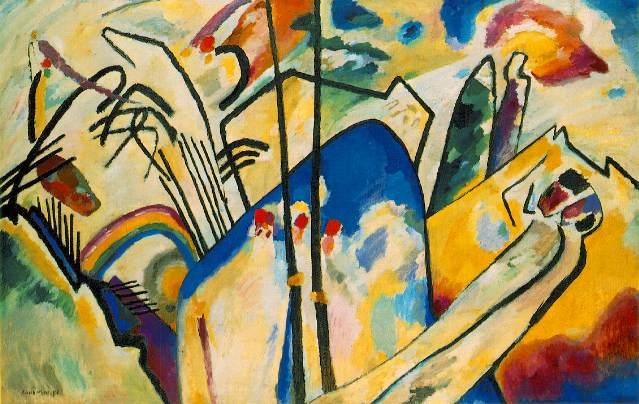
Composition IV - 1911

Composition IV is one of his major works - esp during his transition phase from depictive shapes to abstraction.Kandinsky freed lines off the function as just outlines and created a certain pictorial vocabulary (I love the expression, freeing lines of outline function. True isn't it how warped we are and use lines as just geometric slave-frames!) that really placed equal importance and emphasis on lines and colour.

According to him, a composition is "made up of the contrasts between masses, lines and colours, and only secondarily of objects to which the representation alludes". Several of the elements in Comp. IV such as the mountain, the Cossacks, the rainbow at the back, the twin figures or the gallopping horses in the top left hand section refer to predetermined objects and figures. Of course, abstractionists would readily notice that. Conservative naturalistic and realistic minds would take a while to figure out. But this is Expressionism we are talking. And the Man of the Bauhaus Movement!

The combined effect of primary and secondary motifs (and thematic constructs to go with it), the edgy but deliberate nervous and patchy style of painting, the stark colourfulness and powerful imagination veil the picture's fundamental structural composition.

Look how the vertical axis divides the picture so effortlessly into two halves: the mountains with the motifs depicted on top of them provide almost a third section. For a desultory eye, the 3rd section is almost part of the second. But not really so! A diagonal line adds a certain kinetic - even dynamic - touch to this composition.

Watch out for other compositions. And my links to a Kandinsky web-page in the Links section shortly, comprising jpg reproductions of his works. They are available all over the web. But am compiling them for an avid Wassily enthusiast.